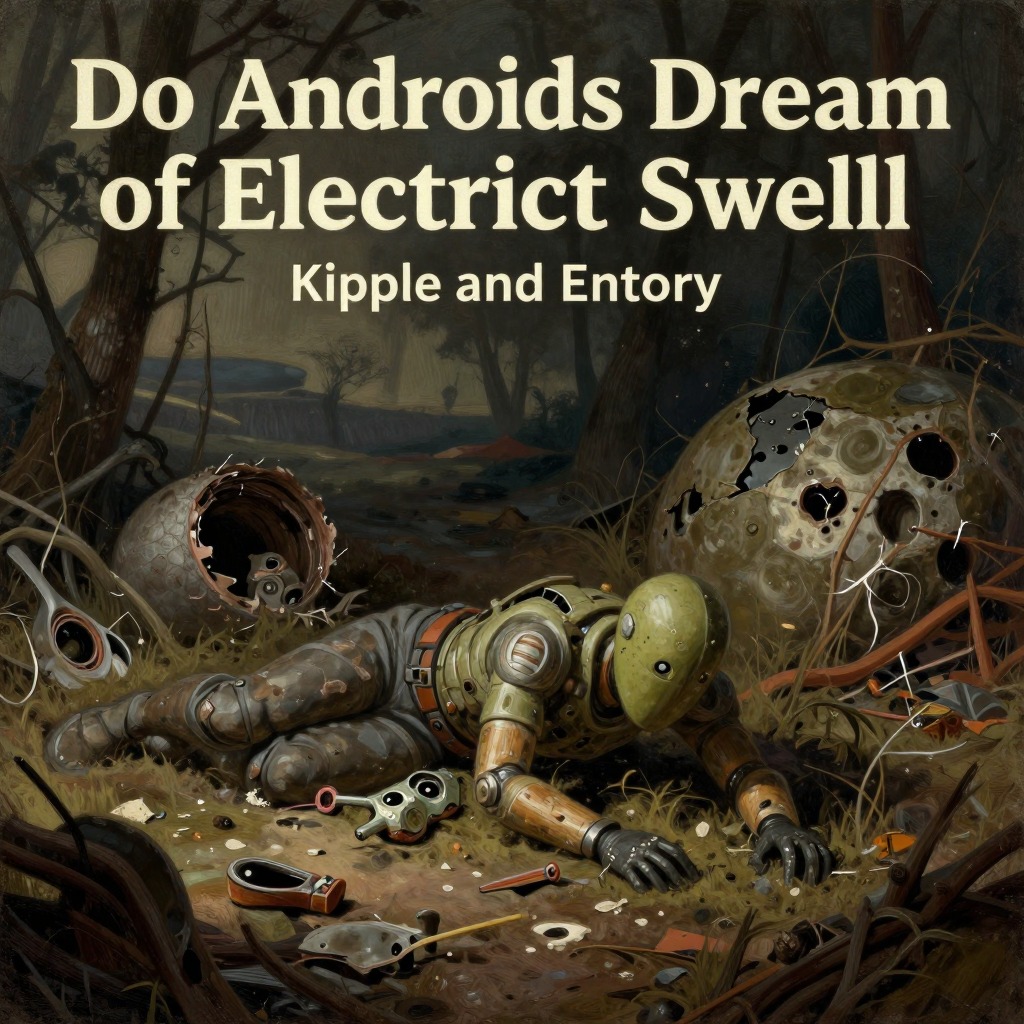
First Law of Kipple
The First Law of Kipple is a principle of universal entropy articulated by the special John Isidore, who lives alone in a decaying, largely abandoned apartment building. It encapsulates the relentless, self-perpetuating process by which useless, discarded objects—kipple—accumulate and overwhelm all living or orderly space, mirroring the broader radioactive and spiritual decay of Earth after World War Terminus.
Definition and Origin
Isidore first explains the concept to his new neighbor, Pris Stratton, when she moves into a kipple-ized apartment. He defines kipple as "useless objects, like junk mail or match folders after you use the last match or gum wrappers or yesterday's homeopape." The First Law, which he states as "Kipple drives out nonkipple," operates like Gresham's law about bad money: in any space where no one actively fights it, kipple inevitably multiplies and replaces functional, meaningful objects. Isidore notes that when nobody is around, "kipple reproduces itself," so that leaving any kipple around an apartment overnight results in twice as much by morning.
Operation and Consequences
The law is not merely a domestic observation but a cosmic principle. Isidore explains that "no one can win against kipple, except temporarily and maybe in one spot," as he has done in his own apartment by creating a fragile stasis. He warns that eventually he will die or leave, and then "the kipple will again take over." This process is described as a universal force: "the entire universe is moving toward a final state of total, absolute kippleization." The only exception Isidore acknowledges is "the upward climb of Wilbur Mercer," the central figure of Mercerism, suggesting that the spiritual fusion of empathy offers a temporary, transcendent resistance to this entropic decay.
Connection to the World's Decay
The First Law of Kipple is deeply tied to the novel's setting. The abandoned apartments Isidore inhabits are described as "completely kipple-ized," filled with the possessions of those who died or emigrated. The building itself, like all its counterparts, falls "day by day, into greater entropic ruin," with everything eventually merging into "mere pudding-like kipple piled to the ceiling." This physical decay parallels the radioactive dust that has contaminated the planet, the extinction of most animal species, and the moral decay of a society that hunts androids. The law thus functions as a metaphor for the novel's central themes: the inevitability of decline, the fragility of life and meaning, and the constant, losing battle against chaos and emptiness.
Narrative Significance
The First Law of Kipple is introduced by Isidore, a character whose diminished mental faculties (he is a "chickenhead") make him acutely sensitive to the world's silence and decay. His explanation to Pris, who is later revealed to be an android, underscores the fundamental difference between human and android experience: humans feel the weight of kipple and the loss it represents, while androids, lacking empathy, do not. The law also resonates with the novel's treatment of electric animals and androids themselves, which are forms of kipple—artificial, soulless objects that mimic life but cannot truly participate in the cycle of life and death. Rick Deckard's electric sheep, which he must tend "as if it lived," is a prime example of kipple that demands care but offers no genuine connection. The First Law thus serves as a bleak, philosophical underpinning for the novel's exploration of what it means to be alive in a dying world.